


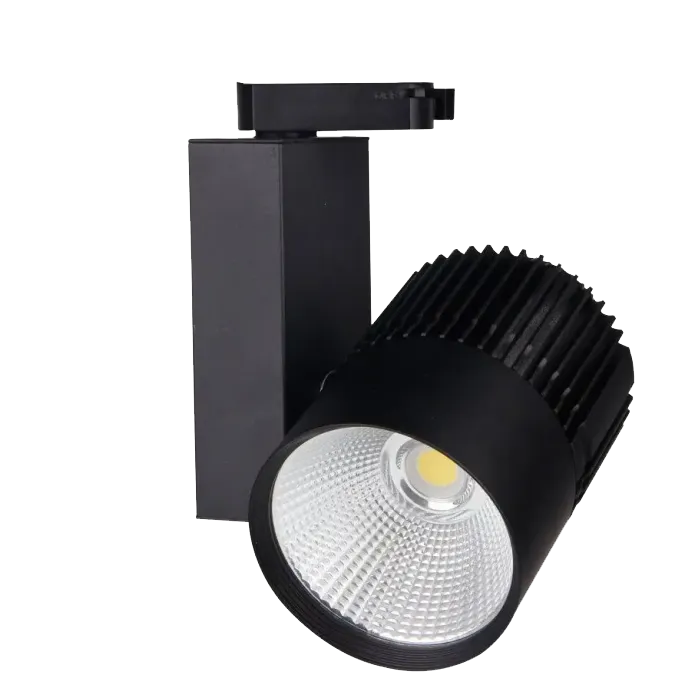
Track lighting has quietly moved out of the gallery and into the kitchen — but it trips up more buyers than almost any other fitting, because the thing people call “track lighting” is actually three or four incompatible systems wearing the same name. Get the system right and it’s the most flexible light in the house. Get it wrong and you own a rail that won’t take the heads you like.
This is a straight guide to choosing track lighting for a UK home, with notes for small retail and studios: what it’s genuinely good at, the compatibility trap nobody warns you about, and when a row of downlights would serve you better.
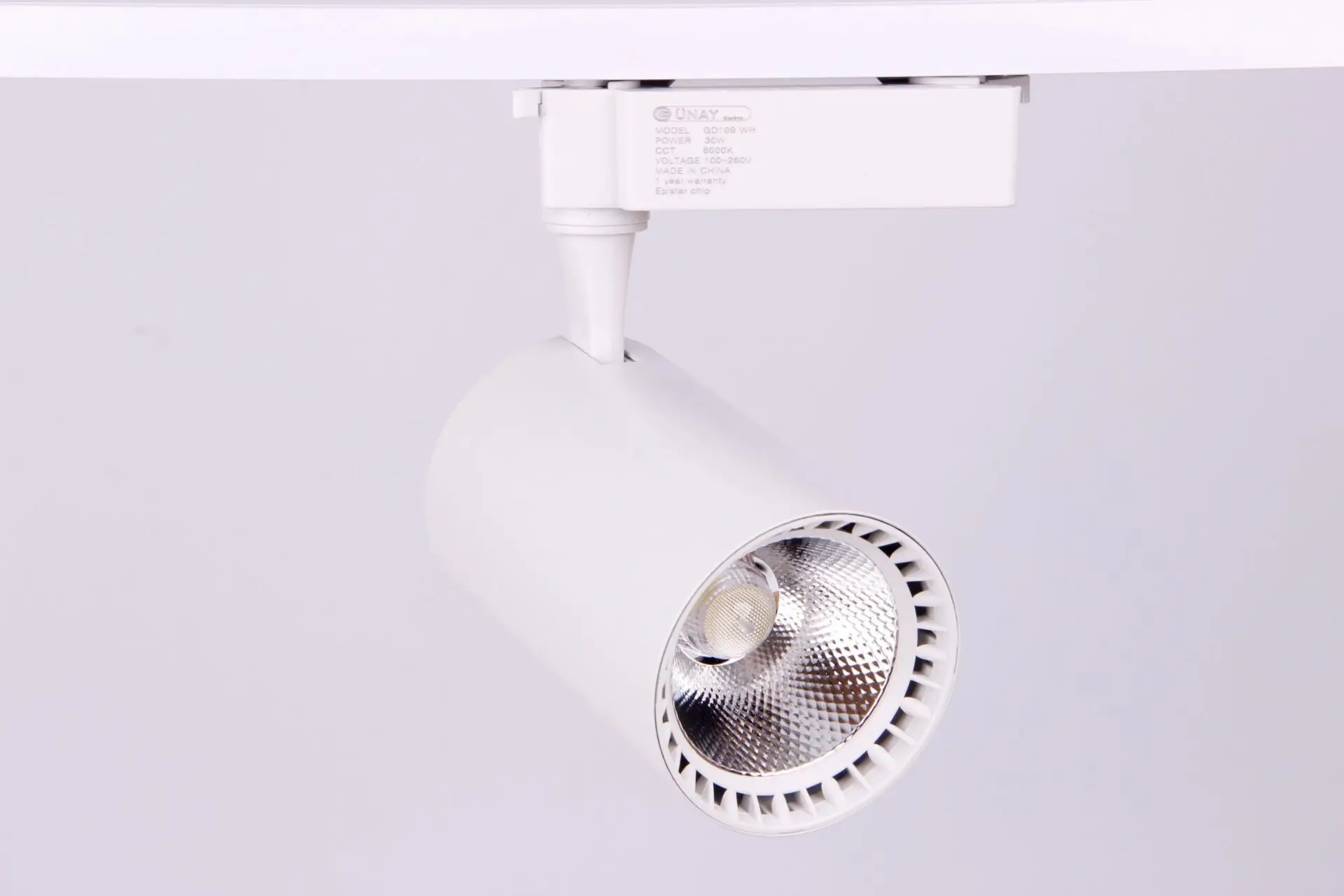
What track lighting is actually good at
Track lighting is directional light you can slide, aim and add to. That makes it brilliant at three jobs: accenting (artwork, a shelf, a stone wall), task light exactly where you stand (a worktop, a desk, a reading chair), and lighting awkward ceilings that can’t take recessed fittings.
That last point is the one people miss. A downlight needs a ceiling void to sit in and, in most UK homes, a fire-rated hood where it breaks the ceiling. Track is surface-mounted, so it needs neither. On a concrete ceiling, a sloped or vaulted loft conversion, a boarded-over Artex ceiling, or a rented flat where you can’t start cutting holes, track is often the only sensible way to get proper directional light up there.
What track is not is a shortcut to good ambient lighting. A single run of spots pointed straight down gives you a striped room — bright pools and dark gaps. Treat it as one layer among several, the same way you’d plan a room in layers, not as the only light in the room.
The compatibility trap: single-circuit vs three-circuit
Here’s the part that costs people money. Mains track comes in two flavours, and they are not interchangeable.
- Single-circuit track carries two conductors — live and neutral — so every head on the rail switches and dims together, off one switch. It’s cheaper and it’s all most homes need.
- Three-circuit track (sometimes called three-phase) carries four conductors, so you can split the heads into three groups that switch or dim independently — one rail, three “scenes.” That’s what shops, showrooms and open-plan offices use.
The trap: a three-circuit head won’t work on single-circuit track, and single-circuit heads don’t belong on a three-circuit rail. Worse, the physical track profile isn’t standardised between manufacturers — one brand’s spotlight often won’t clip into another brand’s rail, even when both are “single-circuit.” So the golden rule is simple: buy the track, connectors and heads as one system, from one range, and buy a little more track than you think you need. You’re not just buying spotlights; you’re buying into an ecosystem.
GU10 heads vs integrated LED — which to buy
Once you’ve picked a system, you choose heads. There are two kinds:
- GU10 spotlights take a standard, replaceable GU10 LED bulb. When one fails you swap a cheap bulb, and you can change the beam angle or colour temperature any time by changing the lamp. For a home, this is usually the smart choice.
- Integrated LED heads have the LED built in, with a proper optical lens for a crisp, glare-free beam and higher output. They look sleeker and perform better for accent work — but when the LED finally dies, the whole head is scrap.
Whichever you pick, the specs that matter are the same. For beam angle, roughly 15–24° for accenting a picture or object, around 36–40° for task light over a worktop, and about 60° for a general wash. For colour temperature, 2700K for a warm living space, 3000K as a safe all-rounder in kitchens and open-plan, and 4000K cool white only where you want crisp detail. And check the CRI: aim for CRI 90+ (Ra90) anywhere colour matters — kitchens, artwork, retail — because cheaper Ra80 lamps make food and fabrics look flat.
Mains track vs 48V magnetic track
The big shift of the last couple of years is magnetic track. Instead of 230V mains running the whole length, a driver steps the supply down to 48V, and the fittings — spots, mini-pendants, linear bars, even small floods — snap onto a recessed or surface channel magnetically, with no tools and no visible fixings. You can move them along the rail with a fingertip.
The appeal is real: the profiles are slim (often around 20–30mm wide), the look is minimal and architectural, and the low voltage makes the fittings safe to reposition without an electrician. The trade-offs are just as real — magnetic systems are proprietary (that ecosystem lock-in again), they cost more up front, and they need a matched driver sized to the load. For a design-led new build or a full renovation, magnetic track earns its price. For a quick upgrade over a kitchen island, a good mains GU10 track still does the job for far less.
Track lighting or downlights? A simple rule
Because we’ve just published a full guide to LED downlights, it’s worth being blunt about when each one wins.
Choose downlights when you want even, unobtrusive ambient light across a standard plasterboard ceiling and you’re happy to commit to fixed positions. Choose track lighting when the ceiling can’t be cut into, when you’ll want to re-aim or add lights later, or when the job is accenting and task light rather than a flat wash. In a lot of open-plan kitchens the best answer is both: downlights for the base layer, a short track to pick out the island or a run of artwork. For the island itself, weigh a track against dedicated kitchen lighting and pendants before you decide.
Getting it right in a UK home
A few practical things that save grief:
- Mind the load. A mains track run has a maximum rating — quality track is usually good for 16A (around 3,680W at 230V), far more than you’ll ever draw with LED heads pulling only 4–7W each. But budget kits can be rated much lower, so check before you load a long rail.
- Dim at the lamp and the switch. If you want to dim, use dimmable heads or GU10s and a trailing-edge LED dimmer. Mismatched dimmers are the usual cause of flicker and buzz.
- Position for the wall, not the floor. To light art or a feature wall, mount the track roughly 0.6–1m out from the wall and aim the heads at about 30°. Too close and you get glare and hotspots; too far and you light the floor.
- It’s all LED now anyway. Track used to mean hot, short-lived halogen GU10s; since the UK stopped selling most halogen bulbs in September 2021 it’s LED throughout — which the Energy Saving Trust notes uses around 80% less electricity than the halogens it replaced.
The one thing to take away: decide on the system first — single- or three-circuit, mains or magnetic — then choose heads to match. Get that order right and track lighting is the most adaptable light you can own.
You can browse our LED track lighting range, with matching heads and connectors, in the shop — free UK delivery on orders over £50. Not sure a track suits your ceiling? Call the team on 0161 211 3514 for a straight recommendation before you buy.