


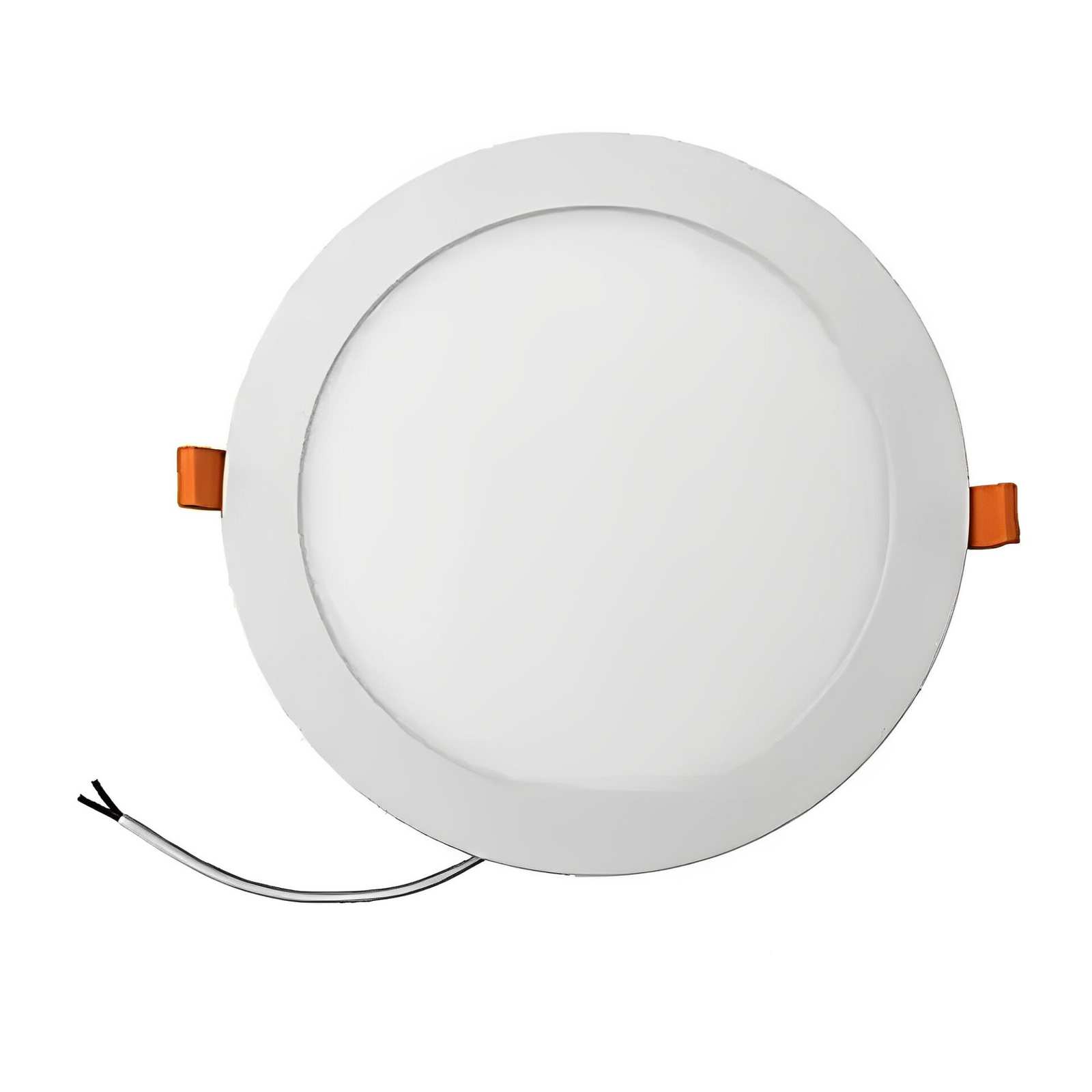
LED downlights look like the easy decision: pick a slim white fitting, dot them evenly across the ceiling, job done. That instinct is exactly why so many UK homes end up with a bright ceiling, dim worktops and a set of fittings they will be ripping out within five years. Plan them properly and you only light the room once. Here is how to get the number, the placement and — the part almost nobody explains — the type right.
How many LED downlights do you actually need?
The builder’s default is a symmetrical grid of spots roughly 1.2m apart. It looks neat on a drawing, but it lights the floor and the top of your head rather than the places you actually use. So start from the room, not the ruler. Decide where light needs to land — the worktop, the hob, a reading chair, the sink — and position fittings to cover those first. Then add a few for general fill.
As a starting point for even ambient light on a standard 2.4m ceiling, space fittings at about half the ceiling height apart (roughly 1.2m) and keep the outer row 0.5–0.75m off the walls, so the light washes the walls instead of leaving them in shadow. And resist the urge to over-light: a 4m x 4m living room does not need twelve spots. Six well-placed 4–5W fittings at around 400 lumens each, plus a lamp or two, will beat a ceiling peppered with LED downlights every time.
The mistake that leaves your worktop in shadow
Downlights throw light straight down. So if you stand at a worktop or hob with a spot on the ceiling behind you, your own body casts a shadow onto the exact surface you are trying to see. It is the single most common complaint we hear about a freshly downlit kitchen.
The fix is placement, not more wattage. Put the fitting between you and the wall — over the front edge of the worktop rather than behind you — and let dedicated task lighting do the close work. Under-cabinet LED strip lighting is far better over a worktop than any ceiling spot, and it frees your kitchen lighting from doing two jobs badly.
Integrated vs GU10: the choice that costs you later
This is the decision that matters most, and it is the one showrooms tend to skip. Recessed fittings come in two flavours. An integrated downlight has the LED sealed permanently inside the fitting. A GU10 fitting is a fire-rated housing that takes a separate, replaceable GU10 bulb.
Integrated units are slim, tidy and often cheaper on the shelf. However, the LED and its driver are one non-serviceable lump. When it fails — and it is frequently the driver, not the diodes, that goes first, sometimes within five to eight years — you replace the entire fitting. That can mean an electrician, a bit of ceiling repair, and hunting down a discontinued part to match the others.
GU10 fire-rated downlights work the other way round. The housing stays put and you swap a £3–4 bulb yourself in seconds. Better still, you can change your mind later: fit a warm 2700K lamp in the lounge, a crisper 4000K over the kitchen, go dimmable, or upgrade to smart lighting — all without touching the ceiling. So for most homes, fire-rated GU10 downlights are the smarter long-term buy. You keep the recessed housings and simply upgrade the LED downlights inside them whenever you like. Integrated fittings really only win where you need the slimmest possible profile or a specific sealed bathroom unit.
Fire-rated LED downlights are not optional
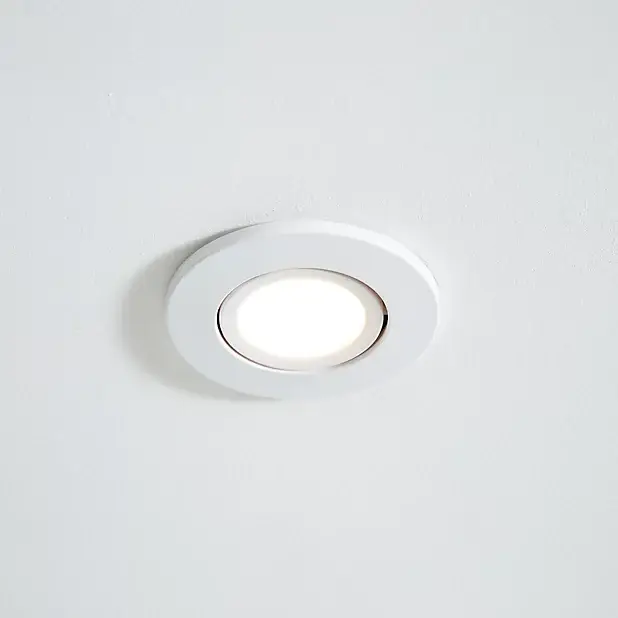
Every downlight cuts a hole in your ceiling. Where that ceiling separates two floors, it is part of your home’s fire protection — and an open hole undermines it. This is not a detail to skip to save a couple of pounds a fitting.
UK Building Regulations (Approved Document B) require any opening in a fire-resisting ceiling to be adequately protected. In practice that means a fire-rated downlight with an intumescent seal that expands in heat to close the gap. Crucially, the rating has to match the ceiling: a typical two-storey home needs 30-minute fittings between floors, while loft conversions and three-storey houses usually need 60 minutes. A 30-minute ceiling needs a 30-minute fitting — a lower rating is simply not compliant. As a bonus, fire-rated housings also cut draughts and reduce sound travelling between rooms.
Getting the light right: colour, beam and IP rating
Once the type is settled, three specs decide how the room actually feels.
- Colour temperature: 2700K warm white for living rooms and bedrooms; 3000K warm-neutral as an all-rounder; 4000K cool white over kitchen worktops, bathrooms and home offices where you want crisp task light. Avoid 5000K–6500K “daylight” indoors — it reads clinical — and keep it consistent within a single room.
- Colour rendering (CRI): aim for CRI 90+ in kitchens and bathrooms so food and skin tones look natural. Treat CRI 80 as the absolute floor.
- Beam angle: a wide 90–120° beam gives even ambient coverage, while a narrower 36–60° beam is punchier for accenting artwork or an alcove. Most ceilings want wide.
- IP rating in bathrooms: any spot over or near the shower or bath needs to be sealed — IP65 in the immediate shower zone. This is notifiable electrical work, so use a qualified electrician and pick fittings made for bathroom lighting.
One more on dimming: if you want to dim, buy dimmable lamps and a compatible trailing-edge LED dimmer. A dimmable LED on an old leading-edge dimmer is the usual reason spots flicker, buzz or refuse to dim below half.
The running-cost reality
If your ceiling still holds 50W halogen GU10s, they are not just dated — most were withdrawn from sale years ago as the UK phased out mains halogens. Swapping them is one of the cheapest efficiency wins in the house.
Here is the honest maths. A kitchen with eight 50W halogen downlights, on for around three hours a day, costs roughly £115 a year to run at the July 2026 price cap of 26.11p per kWh. The same eight in 5W LED downlights cost about £11 a year — a saving of just over £100, for identical brightness. The Energy Saving Trust puts it at £2–3 a year saved for every halogen bulb you replace, and points out that lighting is around 11% of a typical home’s electricity use. LEDs also last far longer — up to 20 times a halogen — so you are not up a ladder every few months either. The wider phase-out of halogen bulbs means LED is now the only sensible way to buy.
The one rule to take away
Plan the light around where you actually stand and sit, buy fire-rated GU10 housings so you can change colour, brightness or smarts later, and always match the fire rating to your ceiling. Do that and you will light the room once — not the ceiling twice.
Ready to spec yours? Browse our fire-rated downlight range and matching GU10 spotlights, with free UK delivery over £50 and 30-day returns.