


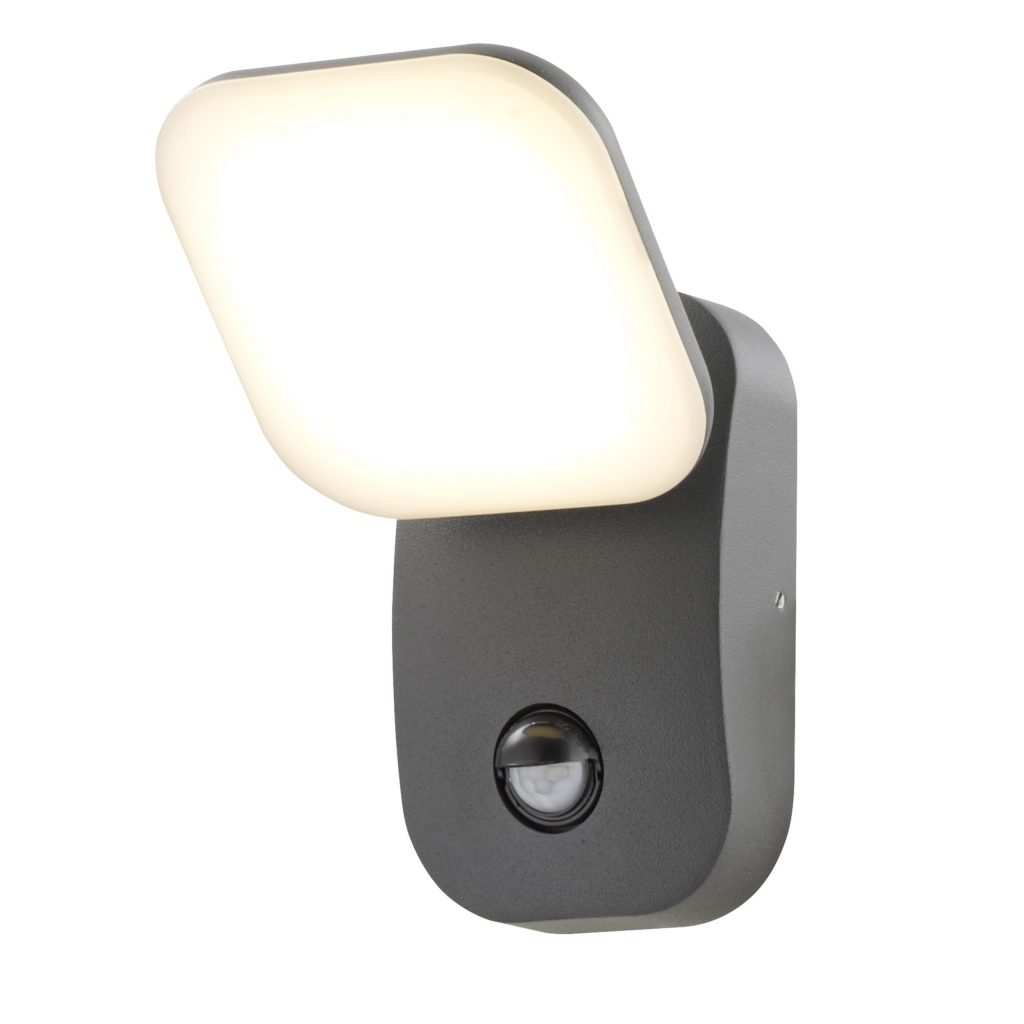
If you want better security lighting, the instinct is to buy the brightest floodlight on the shelf, bolt it high on the wall and aim it at the garden. It feels safer. Most of the time it makes your home easier to break into, not harder.
That sounds backwards, so here is the reasoning — and what to fit instead.
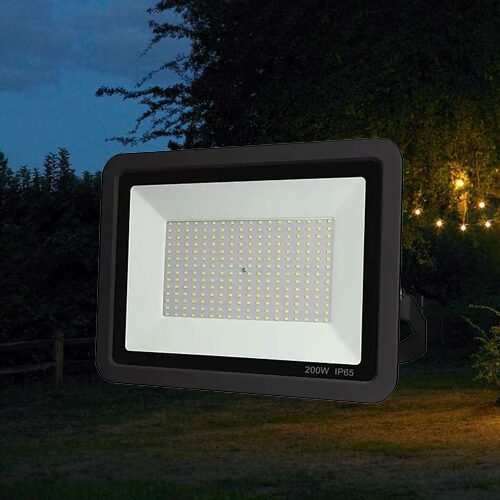
Why brighter security lighting can backfire
Your eyes work on contrast, not absolute brightness. Point a 100W floodlight out at head height and anyone standing in front of it is dazzled, while everything behind the beam drops into deep shadow. You have just built the one thing an intruder wants: a black pool to stand in, right next to a light so harsh nobody can see past it from the house or the street.
The same glare wrecks your CCTV. A powerful flood mounted next to a camera flares the lens and blows out the exposure, so your “evidence” is a white smear instead of a face or a number plate. Good security lighting is even and controlled — a wash of moderate light with no dazzle and no dark corners beats a single blinding blast every time.
How many lumens do you actually need?
Far fewer than the packaging implies. For a typical drive, path or back garden, 1,000–2,500 lumens is plenty — that is a 15–30W LED floodlight. The 50–100W “stadium” floods pushing 8,000 lumens and up are built for builders’ yards and commercial forecourts, not a semi on a residential street, where they mostly annoy the neighbours and flatten your camera footage.
Two settings matter more than raw output:
- Aim. Tilt the head down so the light lands on the ground you want to watch, not out across the street. A flood pointed at the horizon lights up next door and blinds passers-by while leaving your own path in shadow.
- Beam angle. A wide 100–120° beam covers a drive evenly; a narrow beam throws a hot spot with hard shadows either side.
The colour temperature that actually helps
Skip the 6500K “cool daylight” floods. That icy blue-white looks bright in the shop, but it renders colours poorly on camera, throws harsh reflective glare off wet tarmac and cars, and spills further as light pollution. A neutral 3000K–4000K white gives cleaner, more natural colour — the clothing and vehicle detail that actually helps identify someone — with far less nuisance. For most homes, 4000K is the sweet spot.
Motion sensor or dusk-to-dawn — and the running cost nobody mentions
A PIR motion sensor is the better deterrent for most homes: a sudden change in light draws the eye far more than a lamp that has been on all night, and it costs next to nothing to run because it is off most of the time. Three things make or break a PIR:
- Mount it around 2–2.5m high. Higher looks tidy but cuts detection sensitivity.
- Position it so people cross the beam rather than walk straight at it — PIRs detect movement across their field far better than towards it.
- Set the lux level so it only triggers in the dark, keep the on-time short, and angle it away from the pavement so passing cars and foxes don’t set it off forty times a night.
Dusk-to-dawn lighting — a low-level light left on all night — has its place at a constantly used entrance, but it is where the running cost lives. At the July 2026 price cap of 26.11p per kWh, a 30W LED flood costs under a penny an hour. On a motion sensor that is a few pence a year; left on dusk-to-dawn it is roughly £34 a year. The same job done by an old 300W halogen floodlight burning all night would cost around £340 a year — one reason the switch to LED pays for itself, quite apart from the instant, flicker-free start you never got from halogen.
The setup that works best for most homes is both, doing different jobs: a low-output bulkhead or weatherproof wall light giving gentle, constant light at the door, and a separate PIR floodlight that snaps on only when something moves.
Don’t turn your security light into a legal problem
A badly aimed floodlight blasting through a neighbour’s bedroom window isn’t just antisocial — it can be a statutory nuisance. Under the Clean Neighbourhoods and Environment Act 2005, councils can serve an abatement notice over artificial light that unreasonably interferes with someone’s home, and domestic security lights are not exempt (the government guidance sets out how councils handle complaints). Keep the peace and stay legal: tilt the beam below horizontal, fit a shield or hood if needed, and set the sensor so it can’t be tripped from beyond your boundary.
Your security lighting checklist
Before you buy or reposition anything, run through this:
- Output: 1,000–2,500 lm for a domestic drive or garden; save the big floods for large or commercial plots.
- Colour: 3000K–4000K, never 6500K near homes.
- Rating: IP65 for any fitting exposed to the weather; IP44 is only enough under a covered porch or soffit.
- Trigger: PIR at roughly 2–2.5m, aimed so movement crosses the beam, with lux and time set correctly.
- Aim: down onto your own ground, shielded from neighbours and the street.
- Cameras: keep floodlights away from the lens — light the scene, not the camera.
Get those right and a modest 20–30W fitting will out-perform a blinding 100W one on every measure that matters. Browse our LED floodlights and low-glare sensor models, close off the dark corners with ground and paving lights, or add a smart timer for scheduled control. See the full outdoor lighting range, with free UK delivery over £50.
The one rule to remember: security is about control and aim, not brute brightness. A light you can see past is worth more than a light that blinds you.