


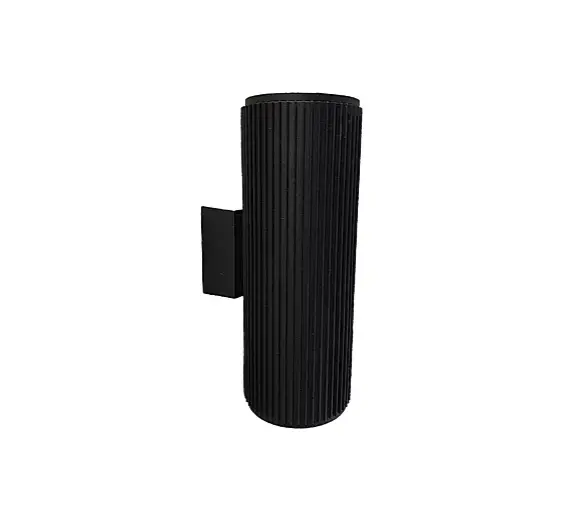
Outdoor wall lights are the one exterior upgrade people buy on looks alone — and then regret on the first properly dark evening. It’s July, the light finally hangs on past nine, and you’re outside after your tea for the first time in months. That’s exactly when the fitting by your door either earns its keep or shows you up: a warm, even glow that makes the whole frontage look considered, or a cold blue-white glare that flattens the brick and picks out every water stain.
Most guides on this stop at “add kerb appeal and choose IP44.” The decisions that actually determine the result are colour temperature, the right IP rating for the exact spot, whether you want a decorative wall light or a humble bulkhead at all, and not blitzing the street while you’re at it. Here’s how to get each of those right.
First decision: a decorative wall light, or a bulkhead?
Almost everyone skips this and goes straight to browsing lantern shapes. But the first question is what the light is for.
A decorative waterproof wall light range — an up/down box, a lantern, a slim modern bar — is about frontage. It’s what people see from the pavement, so it’s allowed to have a bit of personality and throw a deliberate pattern of light up and down the wall.
A bulkhead is about function: a round or oval fitting with an opal diffuser that puts out broad, glare-free light and shrugs off knocks. It belongs over a back door, in a side passage, on a garage, in a porch soffit, above a bin store, or on communal stairs. They’re cheap — a decent IP65 bulkhead runs about £20–£33 plus VAT — and near enough vandal-proof. And the modern matt-black and round designs now read as a deliberate choice rather than something off a hospital corridor.
The rule of thumb: if it’s on the front and people look at it, fit a decorative wall light. If it’s a working spot that will get rained on, knocked, or left on for hours, fit a bulkhead. Plenty of houses want both — a pair of feature lights at the front and a plain, reliable bulkhead round the back.
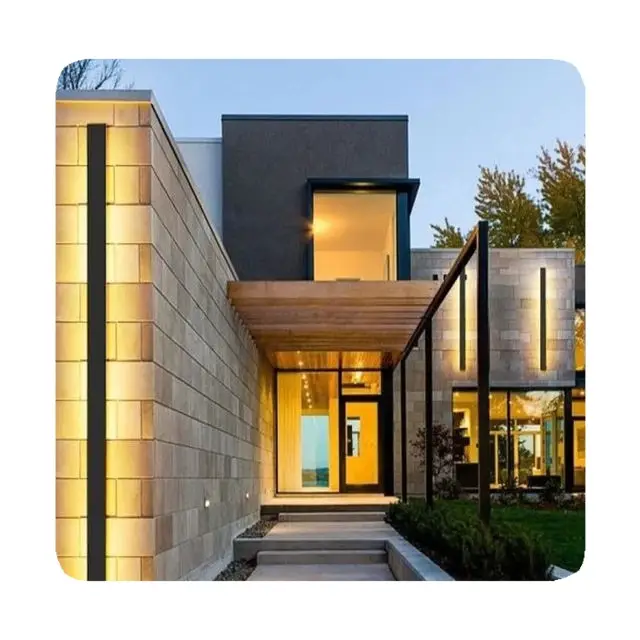
Outdoor wall lights: get the colour temperature right
If you take one thing from this, take this: the number that decides whether your façade looks warm and expensive or like a retail car park is the colour temperature in Kelvin, not the wattage.
- 2700K–3000K (warm white): flatters brick, stone, render, timber and painted surfaces. Use this on anything people actually look at — the front of the house, a porch, a period elevation.
- 4000K (neutral white): crisper and more “alert.” Fine for a side return, a garage, or a spot where security is genuinely the point — but it looks cold and clinical on a period frontage.
- 5000K–6500K (daylight): avoid on a home. It greys out warm materials and shouts “commercial premises.” This is the single biggest reason a new light makes a house look worse, not better.
One more thing: don’t mix colour temperatures across a single elevation. A 3000K lantern next to a 5000K security light looks like an accident. Pick one temperature per face of the building and stick to it.
Match the IP rating to the exact spot, not “the wall”
The IP rating has two digits: the first is protection against dust, the second against water. For outdoor lighting the water digit is what matters.
- IP44 is protected against splashing water. That’s fine only if the fitting sits under a deep porch or soffit that never sees driven rain.
- IP65 is dust-tight and rated against water jets from any direction. It’s the sensible default for any wall that’s actually exposed to the British weather — which is why our outdoor wall lights and bulkheads are IP65 as standard.
Live near the coast? Salt air is far more punishing than rain. Look for marine-grade or 316 stainless steel and a quality powder-coat, otherwise you’ll be replacing rusted fittings after a couple of winters. And there’s no medal for over-specifying — but when you’re genuinely unsure outdoors, go IP65.
Outdoor wall lights: the up/down light trap
The twin-beam up/down wall light is the most-bought “modern” exterior fitting and the most often botched. Before you buy a pair, know what they do to your wall:
- On smooth render or painted brick, you get crisp, architectural scallops of light. This is the look everyone’s after.
- On heavy pebbledash or rough stone, that grazing beam rakes across the texture and exaggerates every lump, patch and old repair. Occasionally that’s the drama you want; more often it just looks patchy.
- Mounting height changes the shape. The higher you fit it, the longer and thinner the scallops stretch. If you want a contained pool of light rather than long streaks, choose a fitting with a tighter beam and don’t mount it too high.
The sleeper problem is corrosion. Cheap up/down lights with mild-steel screws or a thin painted finish rust and leave brown streaks weeping down pale render within a year. Anodised aluminium or stainless fixings in a proper rust-proof, powder-coated housing are what stop that — it’s worth checking the spec before the price.
Don’t blind the street (or your neighbours)
Brighter is not better outside. We made that case about security floodlights recently, and it’s just as true for wall lights. Since 2006, artificial light from a property can be treated as a statutory nuisance in England and Wales under the Clean Neighbourhoods and Environment Act 2005, and a council can act on light that spills into a neighbour’s home. Government guidance suggests keeping the main beam angle below 70 degrees and not over-wattaging in the first place — you can read the official position on how councils handle artificial light nuisance.
In practice: aim fittings downward, use shielded or downward-throwing designs near a boundary, and don’t fit a cold 4000K blaster where a few hundred lumens of warm light would do. A front-door wall light rarely needs to be huge — a modest, warm output reads as “welcome,” while thousands of lumens reads as “interrogation.”
Controls: PIR or dusk-till-dawn?
The control you pick matters as much as the fitting:
- PIR motion sensor: ideal for utility and security routes — a side passage, back door or bin store, where you want light on demand and off again after. Don’t put a PIR on a feature light you want glowing steadily all evening.
- Dusk-to-dawn photocell: comes on at nightfall and off at dawn, no switch, no thought. This is the one for kerb appeal and wayfinding at the front.
- Both together: some fittings hold a low glow all night and boost on movement — the best answer for a front elevation that also needs to react when someone approaches.
Whatever you choose, outdoor wiring is notifiable work in many cases — use a Part P registered electrician and never run a flex out through a window frame to a “temporary” light that becomes permanent.
A simple outdoor wall lights plan that works
Put it together and it’s not complicated:
- Front and porch: one or two warm-white (3000K) decorative outdoor wall lights, IP65, on a dusk-to-dawn sensor, mounted at a consistent height either side of or above the door.
- Back door, garage, side return: an IP65 bulkhead, or a PIR wall light in 4000K if you want that extra alertness where security matters.
- Paths and steps: low-level or paving lights rather than yet more wall glare — you’ll light the ground people walk on without dazzling anyone.
Keep to one colour temperature per elevation, aim everything downward, and buy fittings with rust-proof housings. If you want to compare options, browse our full range of IP65 waterproof wall lights and outdoor lighting — with free UK delivery on orders over £50.
And if you remember only one line: choose the colour temperature first and the fitting second. A £25 bulkhead in warm white will make your house look better than a £150 up/down light in cold blue-white ever will.