


Outdoor wall lights are the cheapest way to make a house look more expensive — and the quickest way to make it look worse. Get the fitting, the colour and the aim right, and a plain brick wall reads as warm and considered after dark. Get them wrong and the same wall looks like a petrol-station forecourt: glare in your eyes, and a hard slab of blue-white light bouncing off the render.
None of the fixes cost more money. After years of speccing exterior lighting for UK homes, these are the six mistakes that come up again and again — and exactly how to avoid each one before you drill a single hole. July is the right moment to sort it, too: long, warm evenings are the whole reason to light a patio or front door properly, so you want it looking good now, not in November.
Mistake 1: outdoor wall lights that are too cool and too blue
Colour temperature is the error I see most. People reach for the brightest, whitest fitting on the shelf, assuming “white” means clean and modern. Outdoors, a cool 5,000–6,500K white does the opposite — it flattens brick and stone, strips the warmth out of the material, and makes a home look like a car park.
For a house façade, warm white between 2,700K and 3,000K is almost always the right call. It flatters brick, render, timber and stone alike and reads as inviting rather than clinical. Keep cooler 4,000K light for a purely functional spot — a side return, a bin store — where you only need to see clearly. If you want flexibility, plenty of modern outdoor wall lights now ship with switchable 3CCT (three colour temperatures in one fitting), so you can set the tone on the wall rather than guessing in the shop.
Mistake 2: lighting the whole street, not your wall
A wall light’s job is to graze your wall and mark your threshold — not to floodlight the pavement, next door’s bedroom and low-Earth orbit. Fittings that throw light sideways or upward create glare (the harsh brightness that makes you squint) and skyglow (that orange dome over every British town). Both are the hallmark of a cheap outdoor scheme.
Aim light downward, keep it close to the surface you’re lighting, and only light what you actually use. This isn’t just etiquette. Under UK law, artificial light from a property can be a statutory nuisance, and councils in England and Wales have powers to act on light that spills onto a neighbour’s home — exterior security lights are one of the most common complaints (GOV.UK guidance on light pollution). If you want genuine security cover, a well-aimed, sensor-controlled floodlight does that job — a decorative wall light shouldn’t be trying to.
Mistake 3: buying up-and-down lights for the wrong wall
Up-and-down wall lights are the defining look of the last few years, and for good reason — that twin cone of light framing a front door looks superb. But they punish the wrong surface. On a heavily textured wall, or one with pebbledash or deep render lines, the crisp “scallop” of light breaks up into a messy smear. They also need a genuinely flat, plumb wall to look symmetrical; mount them over a bumpy or sloping surface and the two cones won’t match.
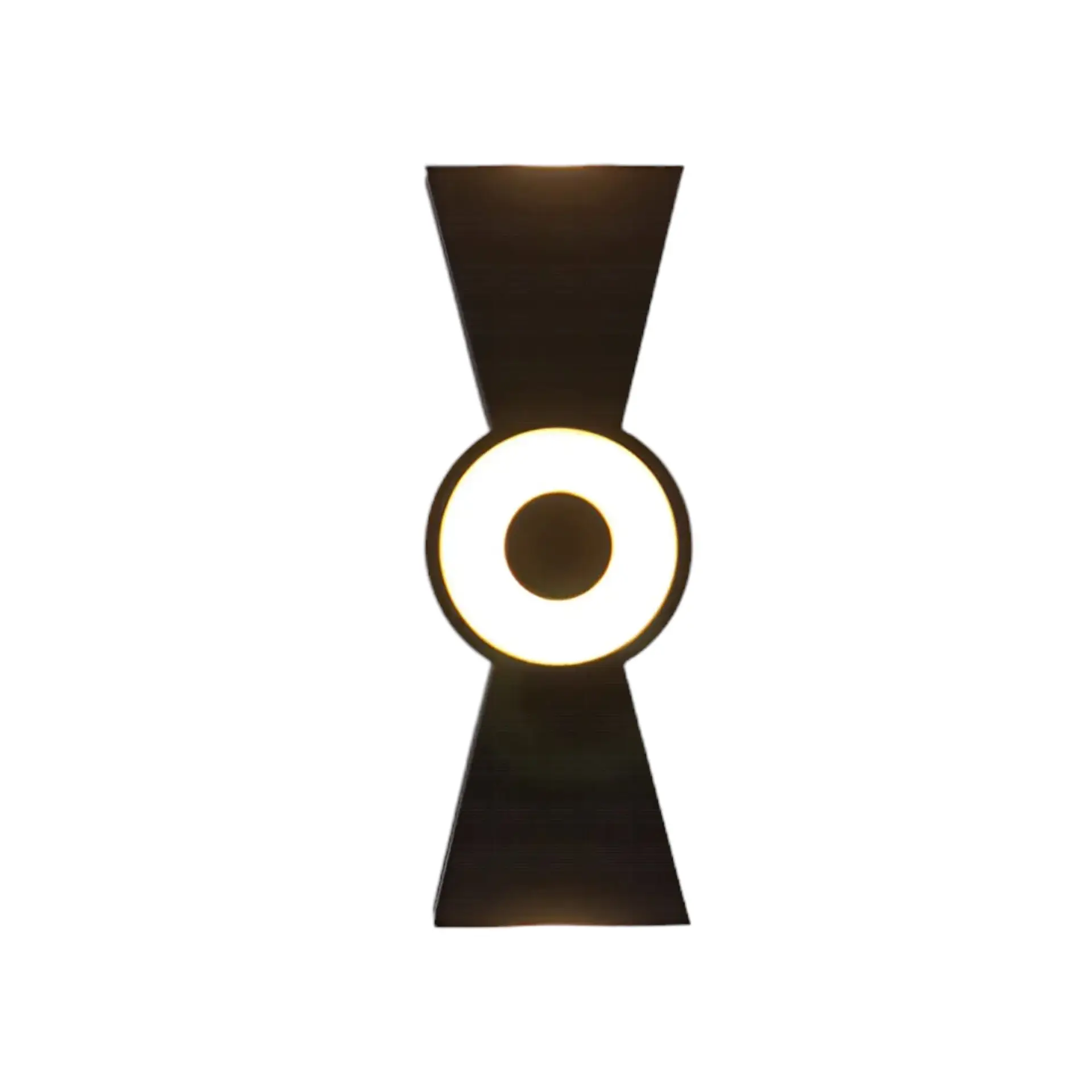
If your walls are smooth render or clean brick, up-and-down fittings are a brilliant, low-cost upgrade. If they’re rough, choose a diffused lantern or a bulkhead that spreads a soft, even wash instead — you’ll get an elegant result rather than a fighting-the-wall one. Space them evenly (roughly every 2.5–3 metres along a run) and mount them at a consistent height, ideally around 1.9–2.1 metres, so the beams clear head height.
Mistake 4: getting the IP rating wrong
Every outdoor fitting carries an IP (Ingress Protection) rating with two digits. The first is protection against solids and dust (0–6); the second is protection against water (0–8). For outdoor wall lights the second digit is the one that matters:
- IP44 — protected against splashing water. Fine for a genuinely sheltered spot, like a deep, covered porch.
- IP54 — adds dust protection and copes with heavier splashing; a sensible middle ground for a semi-sheltered wall.
- IP65 — dust-tight and protected against water jets from any direction. This is what you want on any exposed wall facing British weather, and it’s non-negotiable near the coast.
When in doubt, fit IP65 and forget about it. The small premium over IP44 buys you years of not worrying about a wet winter, which is why the whole of our waterproof wall light range — and every bulkhead we stock — is rated IP65 as standard.
Mistake 5: over-lighting — too many fittings, all too bright
More light is not more welcoming; it’s just more. A single well-placed pair of outdoor wall lights at the front door, at a warm colour temperature, will do more for kerb appeal than six high-output fittings blazing down a driveway. Overdo it and you lose the contrast that makes lighting look intentional — everything is lit, so nothing stands out, and your eyes never adjust enough to enjoy the garden beyond the pool of glare.
Think in layers instead. A restrained wall light to mark the door, a couple of recessed paving or ground lights to pick out a path, and you’re done. Leave the darkness in between — it’s what lets the lit points read as deliberate.
Mistake 6: forgetting the humble bulkhead (and the running cost)
The bulkhead has quietly become one of the smartest buys in exterior lighting. Once the plain oval on the side of a warehouse, modern versions come in matt black, brushed steel and slim round profiles that look at home on a contemporary house — and because they push a soft, even glow rather than a hard beam, they sidestep the glare and scalloping problems above. They’re ideal for side passages, back doors, steps and communal entrances, and many are available with a dusk-to-dawn photocell or PIR sensor so they only run when needed. Emergency-rated versions exist for stairwells and access routes.
Running costs are a non-issue with LED, and worth stating plainly because people still worry about leaving lights on. A 12–14W LED wall light left on for five hours a night costs roughly £6–7 a year to run at the July 2026 price cap unit rate of about 26p per kWh. Swap an old halogen exterior fitting for LED and you’ll cut that lighting energy by up to 80% for the same brightness, according to the Energy Saving Trust — so the sensible move is to light well, not sparingly.
The one rule worth remembering
If you take away a single thing, make it this: warm (2,700–3,000K), aimed downward, IP65 for anything exposed, and fewer fittings than you think you need. That’s the difference between a home that looks considered after dark and one that looks like it’s for sale under floodlights.
Ready to get it right? Browse our full range of outdoor lighting — from IP65 outdoor wall lights and bulkheads to floodlights and paving lights — with free UK delivery on orders over £50 and tailored warranties on every fitting.