



Good kitchen lighting isn’t about how many watts you throw at the room — it’s about where the light lands. Plenty of UK kitchens are bright on paper and still feel gloomy at the worktop, because every fitting sits in the ceiling behind you and you end up chopping in your own shadow. Get the placement right and an ordinary kitchen suddenly works. Here’s how to do it, in the order that actually matters.
Why a bright kitchen still feels dark
The usual culprit isn’t a lack of light — it’s the position of it. Most kitchen lighting is a grid of downlights spaced evenly across the ceiling, often straight down the middle of the room. When you stand at the worktop to prep, your own body blocks that overhead light and casts a shadow onto exactly the surface you’re trying to see. You can add more downlights, turn everything up, and still be working in the dark.
It helps to think in two numbers. General kitchen circulation wants roughly 300 lux — comfortable, easy to move around. But a worktop where you’re using knives and reading labels wants 500 lux or more, which is the level UK workplace standard BS EN 12464-1 sets for detailed manual tasks. A single central light almost never delivers that where you actually stand. So the fix isn’t brighter — it’s lighting the right surfaces from the right direction.
Light the worktop first, not the room
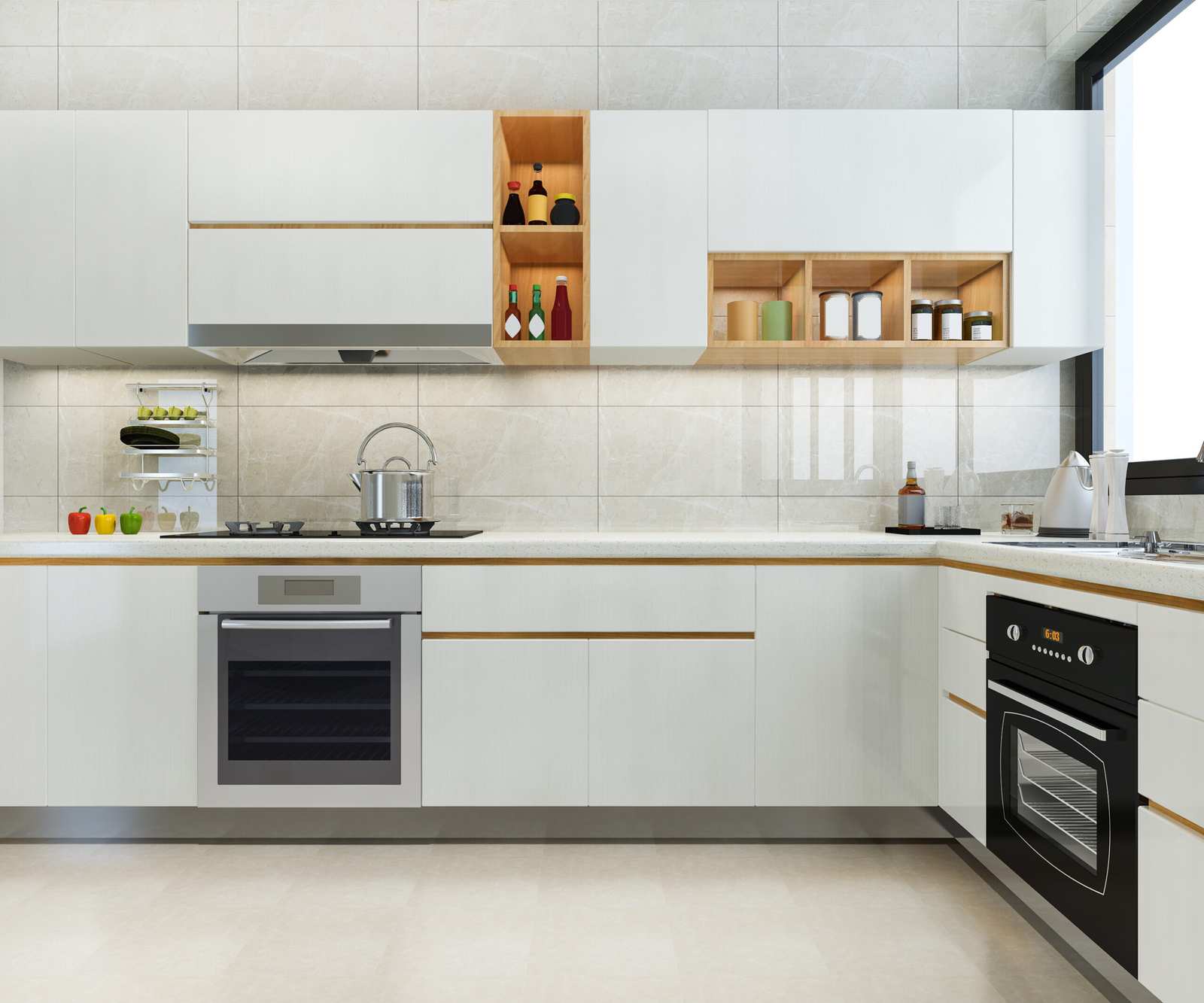
The single highest-impact upgrade in almost any kitchen is under-cabinet task lighting, and it’s the one most people skip. A run of LED strip or slim linear bars fixed under the wall units throws light straight down onto the worktop and splashback — in front of you, not behind — so your shadow stops being a problem.
Two details make or break it. First, position: mount the strip toward the front underside of the wall unit, not tucked against the back wall, so the light reaches the front edge of the worktop where you actually chop. Second, quality of light: aim for 500 lux or more on the surface, and choose fittings with a colour rendering index (CRI) of 90 or higher. CRI decides whether raw chicken, browning meat and ripe veg look their real colour or an off grey — below 90 you’re genuinely guessing. If you cook seriously, 95+ is worth it. Good LED strip lights with a diffuser will do this far more evenly than a couple of spotlights ever could.
Where to put your downlights (the bit everyone gets wrong)
Ceiling downlights still matter for overall fill, but the common mistake is spacing them evenly down the centre of the room. That lights the floor and the top of your head. Instead, pull the row that serves your worktops out over the front edge of the units — roughly 600mm off the wall, above where you stand — so the beam clears your shoulders and reaches the counter. Space them about 1 to 1.2 metres apart along that line, and keep the centre-of-room fittings for general ambience. It’s the same number of lights, just aimed where the work happens.
The island and the table: where pendants earn their place
Over an island or a kitchen table, this is where you can have some fun and add a bit of character. Pendant lights hung about 700 to 800mm above the worktop give you focused light without heads clanging into them — one wide pendant or a row of two or three depending on the island length. Over a dining table the same fitting doubles as the evening centrepiece.
This is where the season earns a mention. In July the kitchen-diner is the heart of the house — bifolds open to the garden, people drifting in and out, meals running long into the light evenings. You want the same room to deliver 500-lux prep light while you’re cooking and then drop to a warm, low glow once everyone’s sitting down. A pendant on its own dimmer is what lets one space do both jobs.
The control that ties it all together
None of the above works as a single switch. The trick to kitchen lighting that feels right at 8am and at 8pm is putting your task lights, your general downlights and your island pendant on separate circuits so you can dial each one independently. Then you can run full task light for a Sunday roast and a warm 10% wash for a glass of wine after.
Two things to get right: use LEDs that are actually marked dimmable, and pair them with a trailing-edge (or smart) dimmer rated for LED loads. The classic kitchen complaint — buzzing or flickering when you dim — almost always comes from a cheap leading-edge dimmer fighting a small LED load. Smart lighting sidesteps the wiring question entirely by letting you group fittings and save scenes in an app, which is handy if rewiring for extra switches isn’t on the cards.
Colour temperature and CRI: the two specs that set the mood
These two numbers decide how your kitchen feels more than the fitting ever will:
- Colour temperature (Kelvin): 2700K is lovely in a bedroom but too yellow over a worktop; 4000K and above can tip clinical and slightly blue. For most UK kitchens 3000K is the sweet spot — warm enough to feel like home, crisp enough to prep under. Whatever you pick, keep every fitting the same Kelvin, or the room looks mismatched.
- CRI: 90 minimum for anywhere you handle food, 95+ if you cook a lot. It’s the difference between food looking appetising and looking grey.
While you’re choosing, LED is simply the sensible option now. The Energy Saving Trust puts lighting at around 11% of the average UK home’s electricity use, and LEDs draw roughly 80% less than the old halogens for the same brightness — so a kitchen full of downlights and strips is exactly the place the efficiency adds up. Choosing the right LED bulbs and fittings in one Kelvin and a high CRI is the cheapest way to make the whole room read as considered rather than cobbled together.
A quick kitchen lighting plan
If you do nothing else, plan your kitchen lighting in this order:
- Put task light on the worktops first — under-cabinet strip, mounted forward, 500 lux, CRI 90+.
- Pull your worktop downlights out over the front edge of the units, not down the centre of the room.
- Give the island or table its own pendant on its own dimmer.
- Standardise on 3000K and high CRI across every fitting.
- Split task, ambient and feature lighting onto separate controls.
Get those five right and brightness looks after itself. Ready to plan yours? Browse our kitchen lighting range — LED downlights, strips, pendants and dimmable bulbs — with free UK delivery on orders over £50. The one rule to remember: light where you stand, not the middle of the room.