



Almost every guide to pendant lights tells you to hang them “75 to 90cm above the surface” and stops there. The trouble is that most of that advice is lifted from American and Scandinavian sources, where ceilings start at 2.7 metres. Drop the same fitting into a typical British room with a 2.4-metre ceiling and you either clip your head on it or stare straight into the lamp over dinner.
So here is the UK version: the heights that actually work under a normal ceiling, the glass mistake that quietly ruins expensive fittings, and how to choose between one big statement pendant and a neat row of them.
Why UK ceilings change the pendant lights rules
The standard ceiling height in a modern British home is 2.4 metres. Older and period properties often have more, but a new-build or a 1930s semi rarely does. That single number is why so much pendant advice online doesn’t quite land — it assumes you have 30 or 40cm more height to give away than you actually do.
It matters more in 2026 than it used to. The look designers have moved to this year is one oversized, sculptural pendant as a room’s focal point, or a loose cluster of hand-blown glass, rather than a tidy line of matching shades. Those bigger fittings look wonderful — but they also make a height or glare mistake far more obvious. With less ceiling to play with, you have to be deliberate: shorter drops, a shade sized to the room, and glass that hides the lamp.
How high to hang pendant lights over a kitchen island
Over a kitchen island, aim for the bottom of the shade about 70 to 80cm above the worktop. That is close enough to put usable task light on the surface for chopping and prep, but high enough to clear the sightline of someone standing at the hob and to keep the lamp out of the eyeline of anyone perched on a stool opposite.
A quick check beats a tape measure here: stand on the far side of the island and look across. If the fitting cuts the face of the person opposite in half, it’s too low — lift it a few centimetres. Because a worktop sits around 90cm off the floor, 70–80cm of clearance lands the bottom of the pendant roughly 160–170cm up, which is about right for a standing kitchen. For the wider picture on layering island lights with downlights and under-cabinet strips, see our guide to kitchen lighting.
How high over a dining table
A dining table is more forgiving, because nobody stands under it. Hang the bottom of the pendant about 70 to 85cm above the tabletop, which usually puts it around 150cm off the floor. Low enough to pool light on the table and feel intimate; high enough that you can still see the person across from you without dodging the shade.
The one rule worth remembering: measure from the floor
If you take a single number away from this, make it 150cm from the floor to the bottom of the pendant, anywhere people sit beneath it. Measuring up from the floor, rather than down from the ceiling, is what keeps a fitting proportionate in a low UK room. In a hallway, over a stairwell, or anywhere people walk underneath, raise that to at least 2 metres so a tall guest clears it comfortably.
The clear-glass trap that ruins expensive pendant lights
Here is the mistake we see most often, and it has nothing to do with price. Someone falls for a beautiful clear-glass pendant with a visible filament lamp, hangs it at the correct height over a table — and is then blinded by it every evening. At 150cm off the floor, a bare lamp sits almost exactly at the eye level of a seated adult. Clear glass does nothing to soften it, so you get glare and a bright dot burned into everyone’s vision at dinner.
The fix is the glass, not the wattage. Choose opal, smoked, amber or textured glass that diffuses the source, or an opaque metal shade that throws light straight down onto the table. It’s the reason most of our pendant lights use smoked and amber glass rather than clear — the shade does the anti-glare work for you. If you love the exposed-filament look, save it for spots where nobody sits directly beneath, such as a hallway or over a console table, and pick a lower-glare frosted lamp. Our filament pendants are built for exactly that.
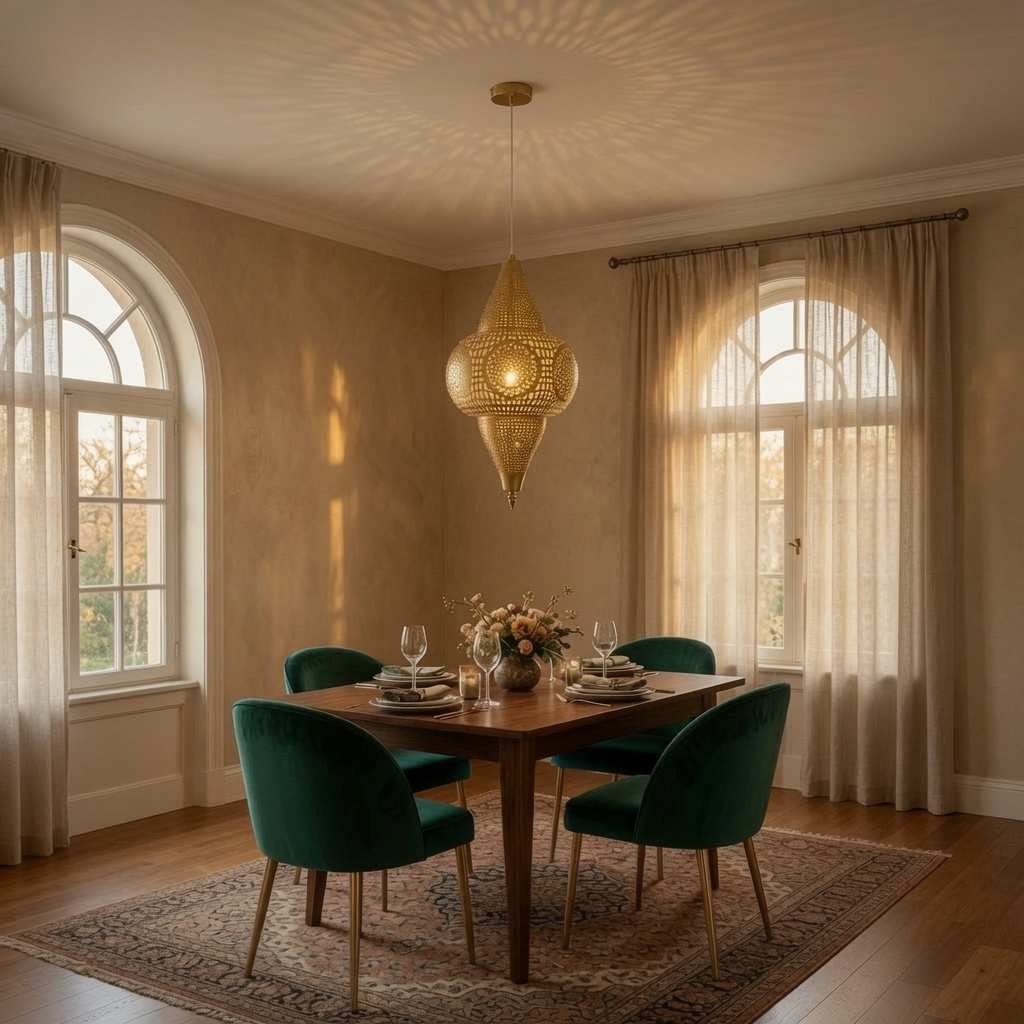
One statement pendant or a row? Getting size and number right
This is where the 2026 trend and old-fashioned proportion meet. A single oversized pendant is very much the current look and works beautifully over a round table or a compact island. Over a long run, though, a row of smaller pendants usually still wins. A few rules keep it balanced:
- Size to the surface. Over a dining table, the shade diameter wants to be roughly one-third to one-half of the table width. For a typical 80–90cm four-seater, that’s a shade of about 20–35cm.
- Span about two-thirds. Over an island, the combined width of your pendants should sit comfortably inside the island length, with clear space at each end rather than fittings hung over the overhang where people sit.
- Odd numbers, even spacing. Three reads better than two or four over a long island. Space multiple pendants 60–80cm apart, centre to centre, and keep them symmetrical.
If the maths puts you off, a pre-wired linear fitting does it for you: one canopy, one fixing point, and the spacing already correct. A three-drop design like the gradient glass linear pendant is a tidy way to light an island without lining up three separate ceiling roses. For a double-height hallway or a stairwell void, step up to a cascade or chandelier sized for the drop.
Colour temperature, dimming and what it costs to run
Get the light colour right and a good pendant looks twice as expensive. Over a dining table, use warm white at 2700K for atmosphere. Over an island, where you’re actually preparing food, 3000K is a touch crisper without going cold. Avoid 4000K and above “cool white” or “daylight” lamps in these spaces — they make food look clinical and flatten the mood. Warm, dimmable LED bulbs are the ones you want, paired with a compatible trailing-edge dimmer so the same fitting handles bright prep and low-key dining without flicker.
Running cost is the last worry. Lighting is only around 11% of the average UK household’s electricity use, and a modern LED draws roughly 80% less than the halogen it replaced, according to the Energy Saving Trust. In practice, leaving a statement pendant on all evening over dinner costs pennies, so choose the fitting you love and light it warmly.
The short version
Measure from the floor up, not the ceiling down: get the bottom of your pendant lights to about 150cm over anywhere people sit, choose diffused glass over clear, size the shade to the surface, and wire it to a dimmer. Do that and a modest fitting will outperform an expensive one that’s hung wrong.
Ready to choose? Browse the full pendant lights range — from single drops to multi-light clusters, all flicker-free LED — with free UK delivery on orders over £50.