


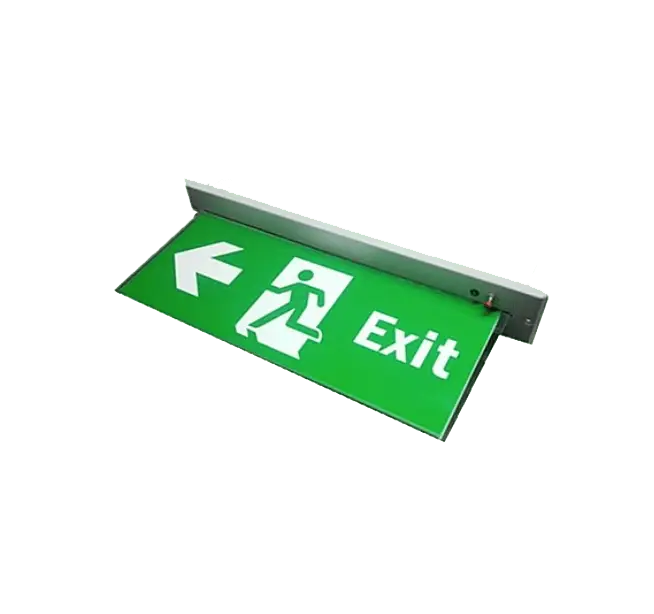
Emergency lighting is the one system in your building you hope never switches on — which is exactly why it gets ignored until an inspection, an insurance renewal or a fire risk assessment forces the issue. If you had yours tested last year, ticked the box and moved on, there is something you need to know: the rulebook was rewritten in 2025.
On 31 October 2025, BS 5266-1:2025 came into force and the old 2016 code of practice was withdrawn. Plenty of building owners are still working to a standard that no longer exists. This is a plain-English guide to what actually changed, what the numbers now are, and what you should do before your next annual test — most likely this summer, while the building is quiet.
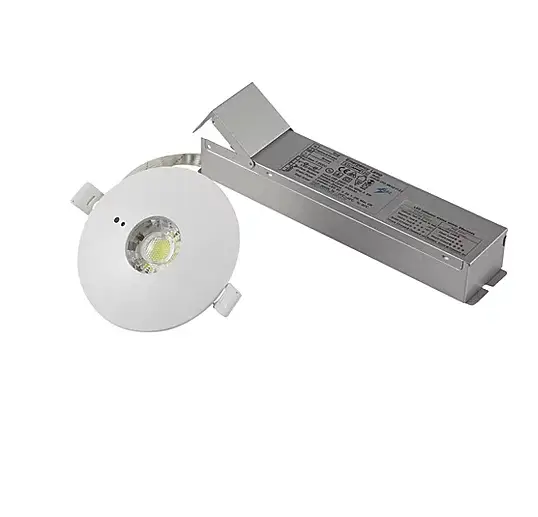
Why the emergency lighting rules changed in 2025
The headline shift is scope. The 2016 code was built around one job: getting people out of a building safely when the mains fails. The 2025 revision widens that to a broader principle it calls “safety of use,” and now formally covers three kinds of emergency lighting:
- Emergency escape lighting — the familiar exit signs and escape-route fittings that light the way out.
- Local area (safety) lighting — light at specific points so people can finish a critical task safely, such as shutting down machinery.
- Standby lighting — light that lets normal activity continue when the power drops, which matters in places like operating theatres or control rooms.
The revision also brings the UK code into line with the latest European performance and system standards, BS EN 1838:2024 and BS EN 50172:2024. So if your fire risk assessment still references the 2016 edition, it is now out of date.
What BS 5266-1:2025 actually requires
Most of the emergency lighting design levels are unchanged, but it is worth knowing the real figures rather than guessing — this is where a lot of installations quietly fail.
Emergency lighting levels that matter
- Escape routes: at least 1 lux along the centre line of the defined escape route.
- Open (anti-panic) areas: at least 0.5 lux at floor level across the open space, so people can find their way to an exit without panic.
- High-risk task areas: at least 15 lux, or 10% of the normal lighting level — whichever is higher — reached within 0.5 seconds.
- Points of emphasis: at least 5 lux of vertical illuminance at fire alarm call points, firefighting equipment, first-aid points, final exit doors and every change of direction or level.
That last one catches people out. It is not enough to light the corridor — you need a fitting positioned so the fire extinguisher, the call point and the turn in the stairwell are all clearly lit.
The resilience rules are stricter
The 2025 code also tightens how systems must be wired, so a single fault cannot plunge a whole escape route into darkness:
- A single fault on a centrally-supplied final circuit must not take out more than 20 luminaires.
- High-risk task areas must be fed from at least two separate circuits.
- Borrowed light — relying on a streetlight through a window, or spill from an adjacent room — can no longer be counted towards your emergency lighting. Every area now stands on its own fittings.
The five-year check almost nobody mentions
Here is the requirement most owners have not heard about. Alongside the routine tests, the standard now recommends a full photometric verification — an actual light-level survey against BS EN 50172:2024 — carried out when the system is commissioned and then every five years. Furniture moves, partitions go up, shelving gets taller, and light levels drift. Therefore a five-yearly survey is how you prove the escape route is still hitting 1 lux, not just that the fittings switch on.
Testing your emergency lighting (and why summer suits it)
The verification survey does not replace the routine regime, which is unchanged and non-negotiable:
- Monthly: a brief functional test — the “flick test.” Simulate a mains failure just long enough to confirm every luminaire and exit sign lights up, then restore power.
- Annually: a full-duration test. The system runs on battery for its full rated time — three hours for most premises — and every fitting must stay lit for the whole period.
Record every test in a logbook. Under the Regulatory Reform (Fire Safety) Order 2005 in England and Wales, the “responsible person” for the premises has a legal duty to keep emergency lighting maintained and evidenced — and a logbook is the evidence an inspector or insurer will ask for. For the full picture, you can read the Government’s workplace fire safety responsibilities.
There is also a practical reason summer is a sensible slot for the annual test. After a full three-hour discharge, self-contained battery packs can take up to 24 hours to recharge — and until they do, your emergency lighting cannot deliver another full duration. You do not want that recharge window falling on a busy trading day, so a quiet week — school holidays, a summer shutdown, a slow retail spell — is exactly when to run it.
Maintained, non-maintained, and the fluorescent trap
Two quick decisions people overthink. Maintained fittings are lit all the time and drop to battery when the mains fails — right for exit signs and places used in darkness, like cinemas. Non-maintained fittings stay off and only come on when the power drops — fine for offices and workshops that are only occupied with the lights on.
The real trap is age. Emergency fittings were exempt from the 2023 fluorescent lamp ban, so an old fitting running a fluorescent or compact-fluorescent tube is still legal to use. However, those tubes are no longer manufactured and stock is drying up. If a fluorescent emergency fitting fails its annual test, you often cannot buy the replacement lamp — so it becomes a like-for-like swap to a modern LED emergency fitting. Batteries are the other wear item: most emergency packs are rated for around four years, so if yours are older than that and struggling to hold three hours, plan to replace them.
What to do before your next inspection
If you own or manage a commercial premises, three moves put you ahead of most: make sure your fire risk assessment references BS 5266-1:2025 rather than the 2016 code; book a photometric survey if you have never had one or it has been five years; and check whether any fittings are still running fluorescent tubes or leaning on borrowed light — the two things the new standard specifically rules out.
Ecobrite supplies LED emergency exit signage and a full range of commercial and industrial LED lighting — from LED panels to battens — with free UK delivery on orders over £50. If you are replacing failed emergency lighting this summer, upgrading to LED clears the fluorescent-spares problem for good and eases the load on your battery packs at the same time.