



If your office, shop or workshop still runs on fluorescent tubes, LED panel lights have gone from a nice upgrade to something you’ll shortly have no choice about. The tubes you’ve relied on for years are being phased out, and once the last of the old stock sells through, you simply won’t be able to buy replacements.
This isn’t another “top five panels” list. It’s what to actually check before you order, the numbers that decide whether the switch is worth it, and the spec details the quick guides skip.
Why your fluorescent tubes are a dead end
Under the tightened RoHS rules on mercury, T5 and T8 linear fluorescent tubes, along with compact fluorescent lamps, have been banned from being placed on the market. The EU pulled the trigger in stages through 2023, and Great Britain has followed. Manufacturing has stopped; retailers can sell through remaining stock, but that stock is running down and getting dearer as it does.
The fittings on your ceiling still work, so nothing fails overnight. But the tubes inside them are now a shrinking, rising-cost resource. Stockpiling is a false economy: spent fluorescent tubes are classed as hazardous waste because of the mercury, so they have to be recycled properly rather than binned. The sensible move is to change the fitting, not chase the last few tubes.
LED panel lights: what actually replaces a troffer
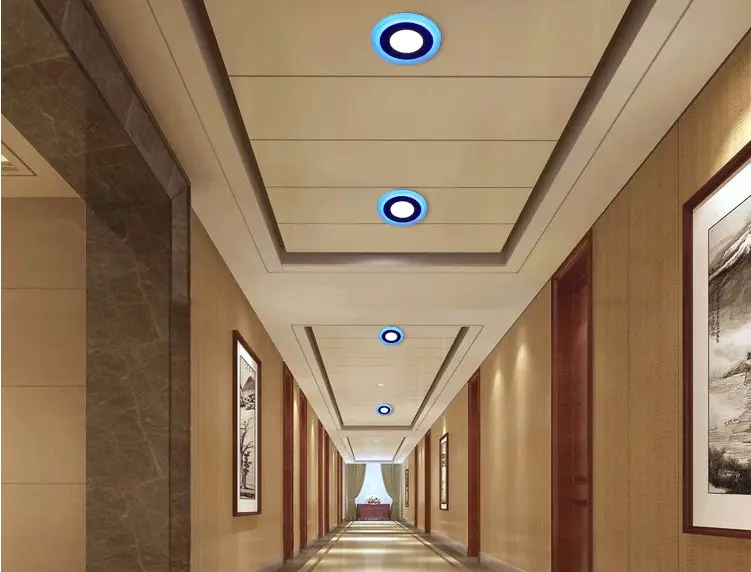
A recessed fluorescent “troffer” sitting in a 600×600 ceiling grid is replaced one-for-one by a 600×600 LED panel. It drops into the same grid aperture, which is why, in a suspended ceiling, the swap is often a same-day job. Longer 1200×300 and 1200×600 panels stand in for the older 1500mm twin-tube fittings.
A modern 600×600 panel draws around 36W and puts out roughly 4,000 lumens — about 110 lumens per watt. That single fitting replaces a four-tube troffer pulling 72–85W, and gives flatter, more even light while it’s at it. For corridors and back-of-house, LED battens are the direct tube-batten equivalent; for tall warehouse ceilings, UFO high-bay fittings do the job a panel can’t.
Spec to the standard, not the old wattage
The most common mistake when buying LED panel lights is matching the new panel to the old fitting’s wattage. That’s the wrong reference. The reference that matters is the light landing on the desk.
The workplace lighting standard, BS EN 12464-1, sets 500 lux maintained on the working plane for general office work, with glare held to UGR ? 19 and colour rendering of CRI ? 80. Storage areas and circulation routes need far less (150–300 lux); detailed drawing or inspection work needs more. So the question isn’t “how many tubes am I removing?” — it’s “how many panels do I need to hit about 500 lux across the desks?” Do it properly and you often need fewer fittings than were there before.
UGR is the figure people miss. Cheap panels are frequently UGR 22–25, which is fine for a stockroom but glary over a bank of monitors, where it shows up as eye strain and screen reflections. For any desk-based space, insist on a genuine UGR<19 figure on the datasheet, not a vague “anti-glare” claim on the listing.
The colour-temperature trap
4000K neutral white is the office default — crisp without tipping into clinical. 6500K “daylight” looks harsh and blue in most UK workplaces, so keep it for particular industrial or inspection tasks. 3000K warm white suits reception, hospitality and retail. Many panels now ship switchable between 3000K, 4000K and 6500K via a small selector on the side, which is genuinely useful when you’re speccing one product across mixed spaces.
Backlit versus edge-lit
Edge-lit panels are slim and light the diffuser from the sides. Backlit panels sit the LEDs directly behind the diffuser. Backlit has caught up and generally overtaken edge-lit on efficacy and evenness, and tends to hold its output better over the years. Unless you specifically need the thinnest possible fitting, backlit is the safer buy.
The running-cost maths
Here’s the part that justifies the invoice. Take a single recessed fitting, on for about 3,000 hours a year, at 27p per kWh — the 2026 UK business-electricity average.
- Old four-tube troffer at ~85W: about 255 kWh a year, roughly £69.
- 36W LED panel: about 108 kWh a year, roughly £29.
That’s around £40 saved per fitting per year, with more than half the energy gone. Across a 40-fitting floor you’re looking at roughly £1,600 a year — before you count the fittings you no longer need because you’ve lit to 500 lux instead of over-lighting the room. Add lifespan on top: quality panels are rated for around 30,000–50,000 hours, against perhaps 10,000–20,000 for a tube that dims and flickers toward the end. That means fewer relamps, fewer ladders and less maintenance downtime. The Energy Saving Trust’s lighting guidance makes the same underlying point: LED is now the default efficient choice for practically every fitting.
Recessed, surface or suspended? Check the ceiling first
The detail that derails jobs is mounting. A suspended grid ceiling takes recessed LED panel lights straight in. A solid plasterboard or concrete ceiling does not — you’ll need a surface-mount frame or a suspension kit, which means extra parts, extra labour and a different lead time. Measure the grid before you order (most UK grids are 595×595mm, sold as “600×600”), and confirm the ceiling type. Frameless “no cut-out” panels exist for plasterboard where you want a flush finish without cutting a large aperture.
One more compliance point: if the space is an escape route, you’ll need emergency (3-hour) versions or a separate emergency luminaire to stay legal. Design that in now rather than bolting it on after the fit-out.
A quick LED panel lights checklist
- Lux: enough panels to reach ~500 lux on the desks (less for storage and circulation).
- Glare: UGR<19 anywhere there are screens.
- Colour: 4000K for offices, 3000K for hospitality and retail, switchable if the spaces are mixed.
- Output: about 4,000 lumens from ~36W (?110 lm/W) for a 600×600.
- Mounting: recessed for grids; a frame or suspension kit for solid ceilings.
- Driver & warranty: a flicker-free driver, and a warranty that actually covers the driver — drivers fail before LEDs do.
- Emergency: 3-hour versions on escape routes.
Making the switch to LED panel lights
The tube ban has effectively made this decision for most businesses. The only real question left is whether you spec it properly or swap like-for-like and end up over-lighting the room. Get the lux and UGR right and the fitting count often falls, which pays for better panels in the first place.
Browse our LED panel lights range, or the wider commercial & industrial collection for battens, high-bay and emergency fittings — UK delivery is free over £50. And if you want the product-by-product rundown, our full guide to the best commercial LED panels goes deeper on specific models.