


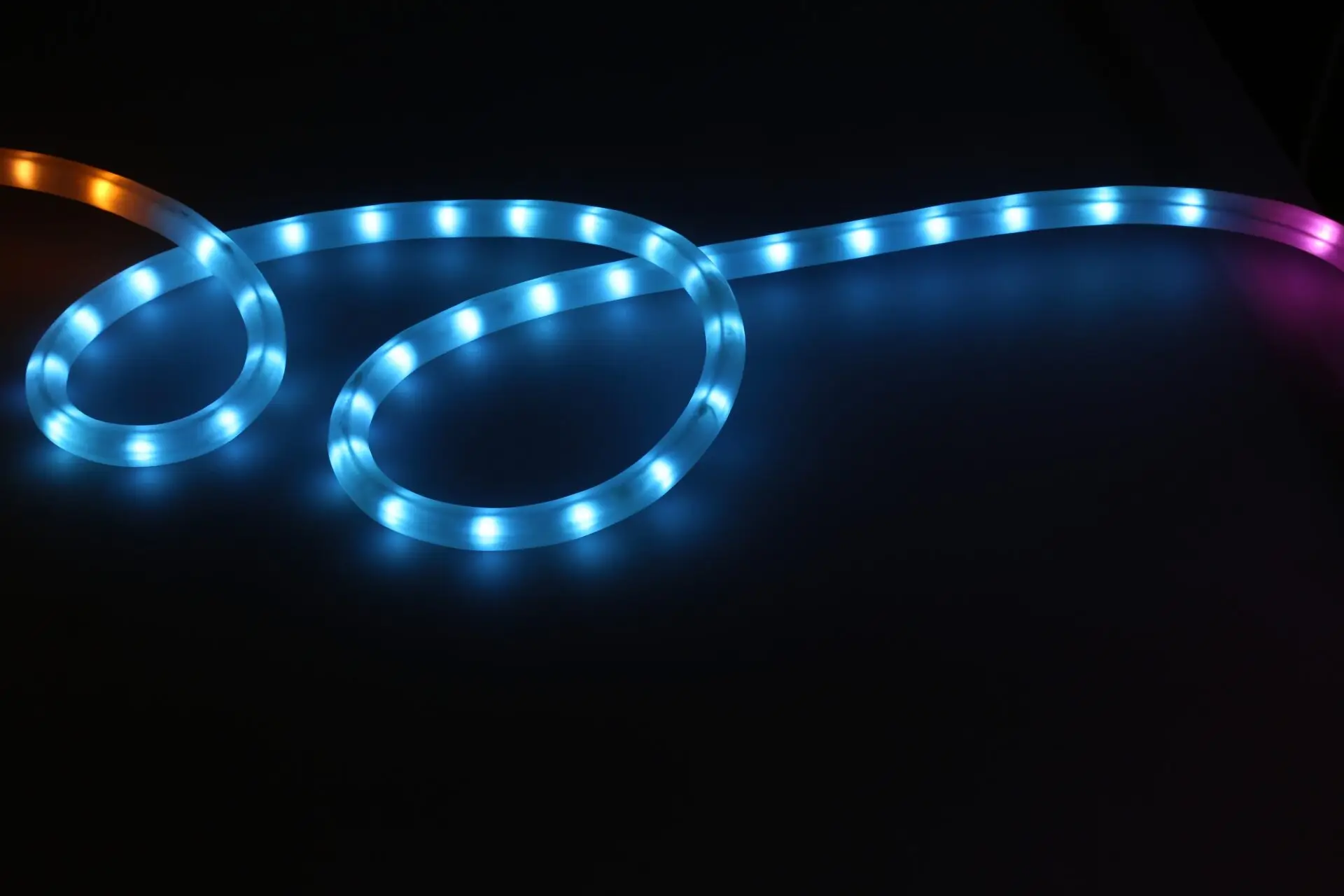
You fitted a reel of LED strip lights, switched them on, and instead of the seamless glow you saw in the showroom you got a row of visible dots, one end brighter than the other, and a faint green cast on the worktop. The strip probably wasn’t the problem. The gap between strip lighting that looks architectural and strip lighting that looks like a gaming rig comes down to about six specifications — and none of them are printed in big letters on the front of the box.
Here is what actually separates a professional finish from a cheap one, and how to get it right first time.
1. You bought LED strip lights on price, not LEDs per metre
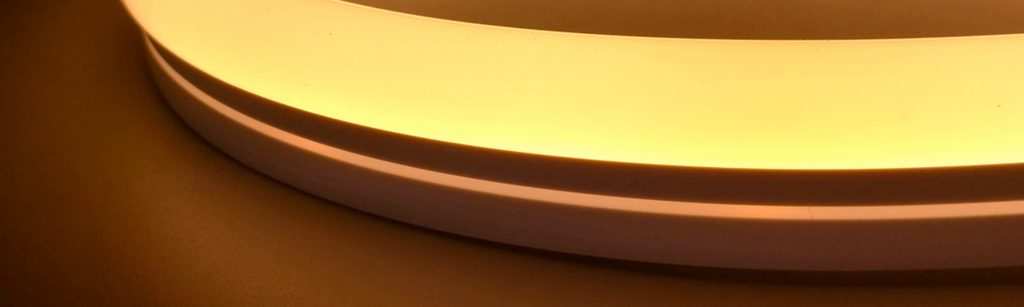
The biggest giveaway of a budget install is visible dotting — a line of individual points instead of one continuous band of light. That is LED density. The cheapest LED strip lights pack just 30 LEDs per metre and you will see every one of them. For anything in direct view, treat 60 per metre as the minimum, and go to 120 or more where the light sits behind a diffuser.
Better still, look at COB tape. COB (chip-on-board) strips replace the spaced-out dots with a dense line of phosphor, so they throw a genuinely dotless glow even close up. For coving, shelf edges and under-cabinet runs, COB is the single upgrade that reads as “designed in” rather than “stuck on afterwards”.
2. You ran one long strip and the far end faded
If your run starts bright and dies off towards the end, that is voltage drop: the current runs out of puff over distance. It is the most common mistake people make with a 5-metre reel of LED strip lights, and it is mostly a question of voltage.
A 12V strip will visibly dim across a single 5-metre run. A 24V strip draws half the current for the same output, so it holds its brightness over roughly double the distance before your eye notices. Three fixes, in order of preference: choose 24V for anything longer than about 3 metres; feed power to both ends of the run instead of just one; or split a long run into two shorter feeds. What you should not do is uncoil ten metres from a single corner and hope.
3. LED strip lights need an aluminium profile
Most people treat the aluminium channel as a cosmetic extra. It isn’t. LEDs hate heat, and heat is exactly what shifts their colour and shortens their life. Stick a strip straight onto plasterboard or an MDF shelf and that heat has nowhere to escape. An aluminium profile works as a heat sink, drawing warmth away from the diodes so they last their rated hours instead of dimming early.
It does a second job too. The frosted diffuser that clips over the top blurs the individual diodes into one clean line and kills the glare that makes cheap strips uncomfortable to sit near. Heat management and a better-looking result from a single part: profiles and the connectors to match are the cheapest upgrade with the biggest visual payoff.
4. Your colour rendering (CRI) is too low
Ever noticed food, timber or skin looking slightly flat and grey under cheap LED strip lights? That is a low CRI — the colour rendering index, which measures how faithfully a light shows colour compared with daylight. Budget strips sit around CRI 70 to 80. For a kitchen worktop, a bathroom mirror or any room where you actually look at colour, insist on CRI 90 or higher (written as Ra ? 90). It is the difference between a worktop that looks appetising and one that looks like a hospital corridor — and it is precisely the number cheap reels leave off the listing.
5. You undersized the driver
The power supply — the driver — is where a lot of installs quietly fail. Undersize it and it runs hot, buzzes, and gives up within a year, sometimes taking the strip with it.
The maths is simple. Multiply the strip’s watts per metre by its length, then add roughly 20% headroom. A 14.4W-per-metre strip over 5 metres pulls 72 watts, so you want a driver rated for at least 90 watts, not a 72W unit running flat out. Always match a constant-voltage driver to the strip’s voltage, and if you want to dim, buy a dimmable driver or a low-voltage controller: a standard mains wall dimmer will not dim a 12V or 24V strip and can damage it.
6. Wrong colour temperature — and wrong IP rating — for the room
Colour temperature sets the mood. Warm white (2700K) suits living rooms, bedrooms and coving; a neutral 3000–3500K works for general light in a kitchen; 4000K is crisp for task areas and worktops. Steer well clear of 6000K “cool white” indoors — that blue-white fridge glow is the fastest way to make an expensive install look cheap.
Then there is water. A dry indoor run only needs IP20. Near a sink, inside a bathroom zone or under a splashback, step up to IP65. For a summer project outdoors — decking, a pergola, a garden bar — you want IP67-rated LED strip lights for full exposure. Matching the IP rating to the room isn’t optional; it is what stops a smart install turning into a fault six months later.
What LED strip lights actually cost to run
This is the good news. LED tape is genuinely cheap to run. A 5-metre run drawing around 50 watts, left on for three hours every evening, costs roughly £14 a year at the July 2026 price-cap unit rate of 26.11p per kWh. According to the Energy Saving Trust, LED lighting uses up to 80% less electricity than the halogen it replaced — so even a generous run of accent lighting barely shows up on a bill.
That reframes the whole decision. Because running costs are trivial, the sensible move is to spend up front on the specs that matter — density, CRI, a properly sized driver and a profile — rather than shaving a couple of pounds off the reel.
The one rule to take away
If you remember nothing else: buy on LEDs-per-metre and CRI, not price-per-metre, and always house the strip in an aluminium profile. Get those three right and even a modest run of LED strip lights will read as architectural. Get them wrong and no amount of clever placement will rescue it.
You can see our full LED strip lights range — flexible tape, aluminium profiles and drivers in one place — with free UK delivery on orders over £50.